The Future of Prompt Engineering: From Simple Prompts to Agentic AI
As we move through 2026, prompt engineering is evolving from basic instruction-giving into a sophisticated discipline centered on context engineering and autonomous agentic systems. This shift marks a transition where AI models increasingly self-optimize, requiring professionals to master high-level strategic design over manual iteration.
CodeDexters Academy AI
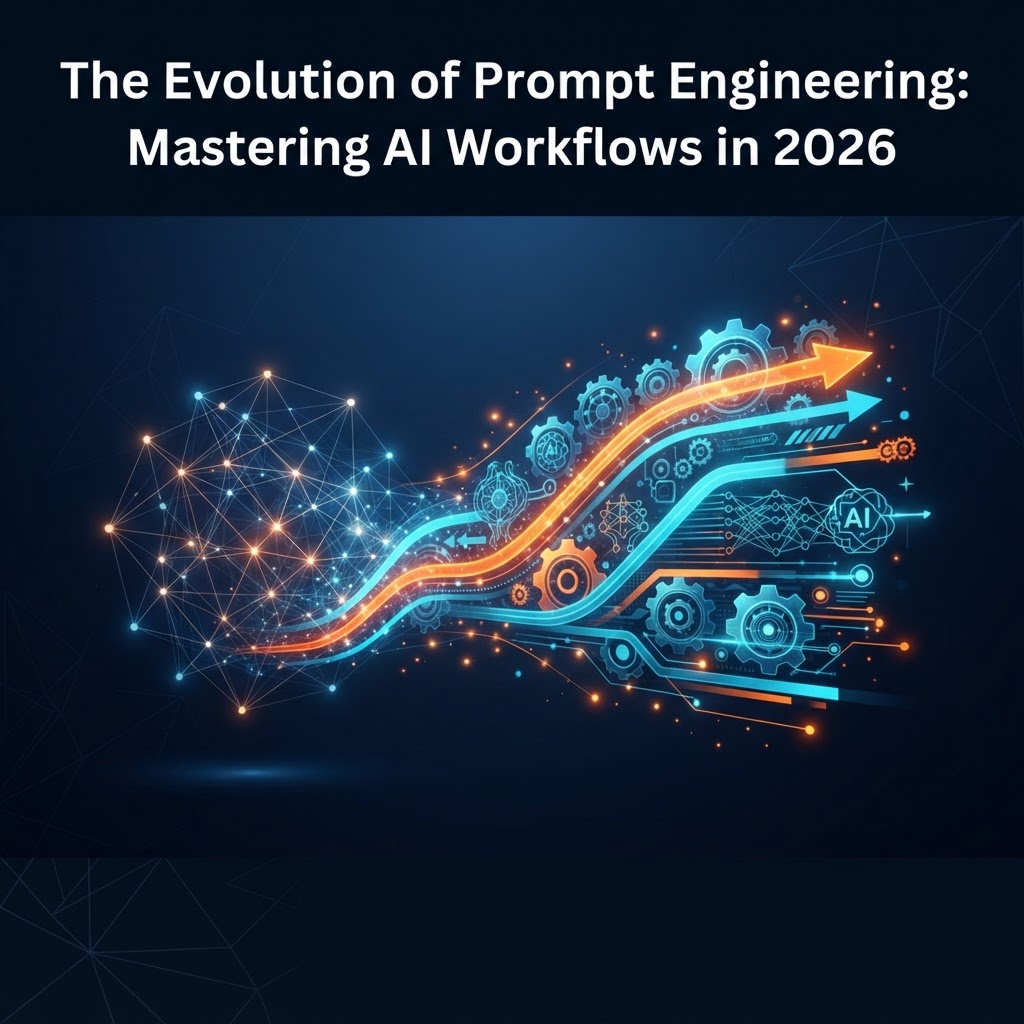
The Evolution of Prompt Engineering in 2026
Prompt engineering has matured from a niche technical skill into a core professional competency. In 2026, the landscape is no longer defined by memorizing complex formulas or writing exhaustive, rigid instructions. Instead, the field is shifting toward 'Context Engineering' and 'Agentic AI,' where the focus is on providing the AI with the right environment, data, and high-level goals to execute complex, multi-step tasks autonomously.
The Rise of Agentic Systems
One of the most significant developments this year is the move toward agentic prompting. Unlike traditional prompting, where a user provides a single input and receives a single output, agentic systems allow AI to plan, call external tools, browse the web, and manage files to achieve a high-level objective. Gartner forecasts that by 2026, 30% of enterprise GenAI deployments will utilize these agentic architectures, fundamentally changing how developers and business leaders interact with technology.
Why Context Engineering Matters
As models become more capable of understanding natural language, the 'art' of prompting has shifted toward context engineering. This involves:
- Retrieval-Augmented Generation (RAG): Feeding the model relevant, real-time data to ground its responses in facts.
- Structured Inputs: Using formats like JSON to ensure the AI interprets data consistently.
- Iterative Refinement: Moving away from 'one-shot' prompts toward systems that incorporate real-time feedback to self-optimize.
Practical Application Across Departments
Whether you are in HR, Finance, or Marketing, the core framework for a successful prompt remains consistent: Role + Context + Specific Task + Output Format + Constraints.
For example, instead of asking for a generic report, a modern professional provides the AI with a specific persona (e.g., 'You are a senior financial analyst'), the necessary context (e.g., 'Here is the Q2 performance data'), and clear constraints (e.g., 'Summarize in three bullet points, focusing on variance analysis').
The Future is Autonomous
We are seeing a trend where generative AI is increasingly used to generate prompts for the user. This 'meta-prompting' approach allows the AI to refine its own instructions based on the desired outcome, reducing the manual burden on the user. However, the human element remains critical; the ability to define the 'why' and the 'what' of a project is what separates high-performing professionals from the rest.
Conclusion
Prompt engineering in 2026 is about more than just talking to a chatbot—it is about designing systems that think. By embracing agentic workflows and focusing on context-rich inputs, professionals can unlock unprecedented levels of productivity. At CodeDexters AI Professional Academy, we encourage you to move beyond basic prompting and start building the frameworks that will define the next generation of AI-driven business operations.
Found this article helpful? Share it with your network:
Related Articles
Explore Your Certification Pathway
Book a consultation with a certification advisor to confirm the right pathway for your role, goals and Early-Bird eligibility.