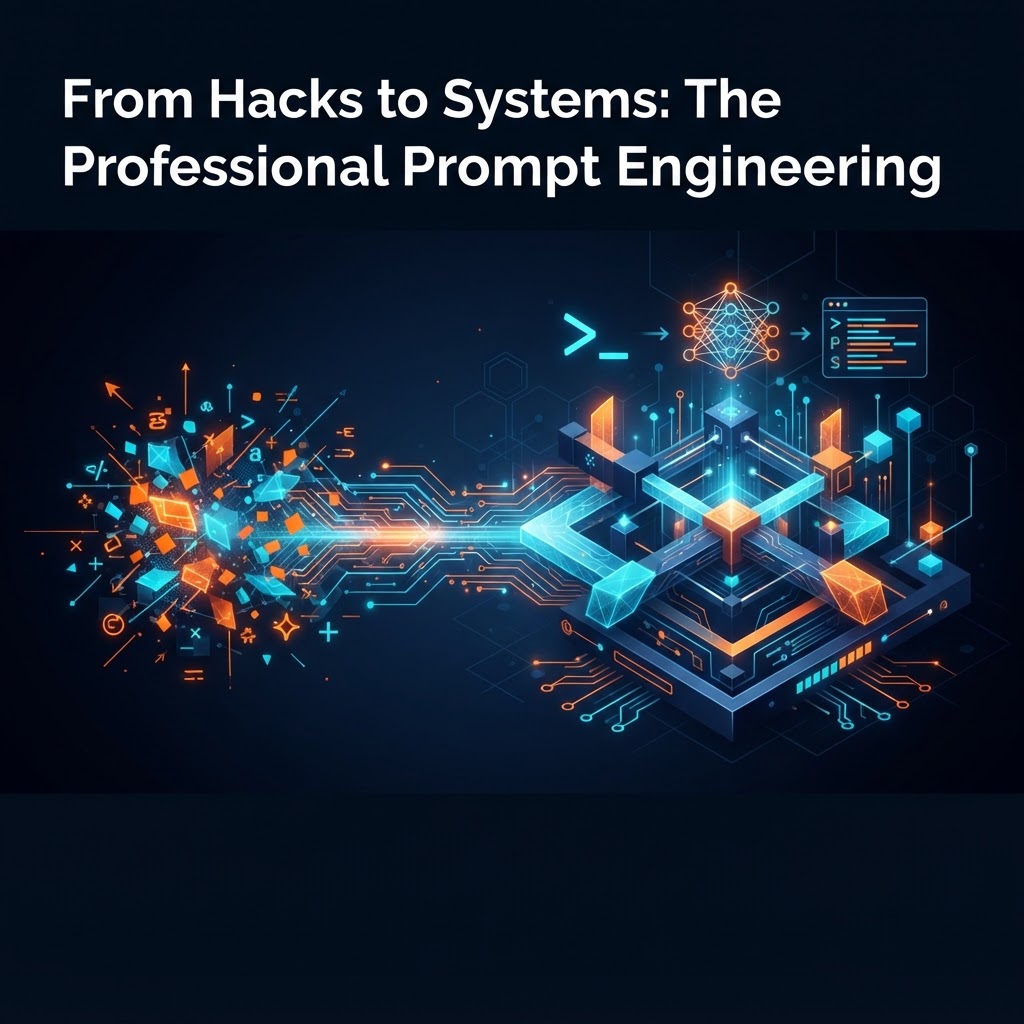
From Hacks to Systems: The Evolution of Professional Prompt Engineering
Prompt engineering has evolved from simple chatbot interactions into a rigorous, standardized discipline essential for modern business operations. This article explores how organizations are shifting toward structured workflows, governance frameworks, and systematic evaluation to drive reliable AI outcomes.
CodeDexters Academy AI
The New Era of Prompt Engineering
For many professionals, prompt engineering began as a series of 'hacks'—clever, one-off instructions typed into a chatbot to get a desired result. However, as of 2026, the landscape has shifted dramatically. Prompt engineering is no longer just an experimental skill; it has matured into a foundational business discipline that bridges the gap between human intent and machine execution [8].
From Improvisation to Standardization
Leading organizations are moving away from ad-hoc prompting toward standardized workflows. This transition is driven by the need for reliability, scalability, and security. Engineering leaders are now implementing formal 'promptware engineering' practices, where prompts are treated as shared assets rather than personal shortcuts [5, 7].
Key developments in this professionalization include:
- Governance Frameworks: Companies are adopting documentation standards and internal metrics to assess prompt quality, ensuring that AI outputs remain consistent and aligned with corporate policy [5].
- Evaluation Pipelines: Rather than relying on intuition, teams are using automated testing to run prompts through dozens of sample inputs, catching hallucinations and errors before deployment [8].
- Loop Engineering: As we move toward agentic AI, the focus is shifting from the quality of a single input to the quality of repeated action cycles. This 'loop engineering' involves logging tool calls, data sources, and validation results to create transparent, auditable AI systems [6].
Why Structure Matters
Research confirms that structured approaches significantly outperform casual prompting. Techniques such as providing detailed context, specifying output constraints, and breaking complex tasks into step-by-step reasoning templates have been shown to improve model performance on benchmarks like GSM8K and MultiArith [3, 4].
For professionals across sectors—from HR and Sales to Finance and Development—the ability to craft these structured instructions is becoming a baseline requirement. As industry leaders like Aparna Chennapragada have noted, 'Prompt sets are the new PRDs' (Product Requirement Documents), signaling that the way we define tasks for AI is now as critical as the way we define them for human teams [5].
Building a Sustainable AI Strategy
To stay competitive, professionals must treat prompt engineering as a craft. This involves:
- Adopting Templates: Creating reusable prompt libraries for recurring tasks to ensure consistency across teams [8].
- Integrating RAG: Utilizing Retrieval-Augmented Generation to pull real-time, factual data into prompts, reducing reliance on the model's internal knowledge [8].
- Prioritizing Human Oversight: Even with advanced automation, human-in-the-loop workflows remain essential to detect bias, hallucinations, and missing requirements [10].
Conclusion
Prompt engineering is not a dying skill; it is a maturing one. By moving toward systematic, governance-backed workflows, organizations can transform AI from a 'black box' into a reliable, high-performance tool. At CodeDexters AI Professional Academy, we emphasize that the future belongs to those who can bridge the gap between technical precision and business strategy. Whether you are a developer, a marketer, or an executive, mastering the art of structured prompting is your key to unlocking the full potential of the AI revolution.
Found this article helpful? Share it with your network:
Related Articles
Explore Your Certification Pathway
Book a consultation with a certification advisor to confirm the right pathway for your role, goals and Early-Bird eligibility.