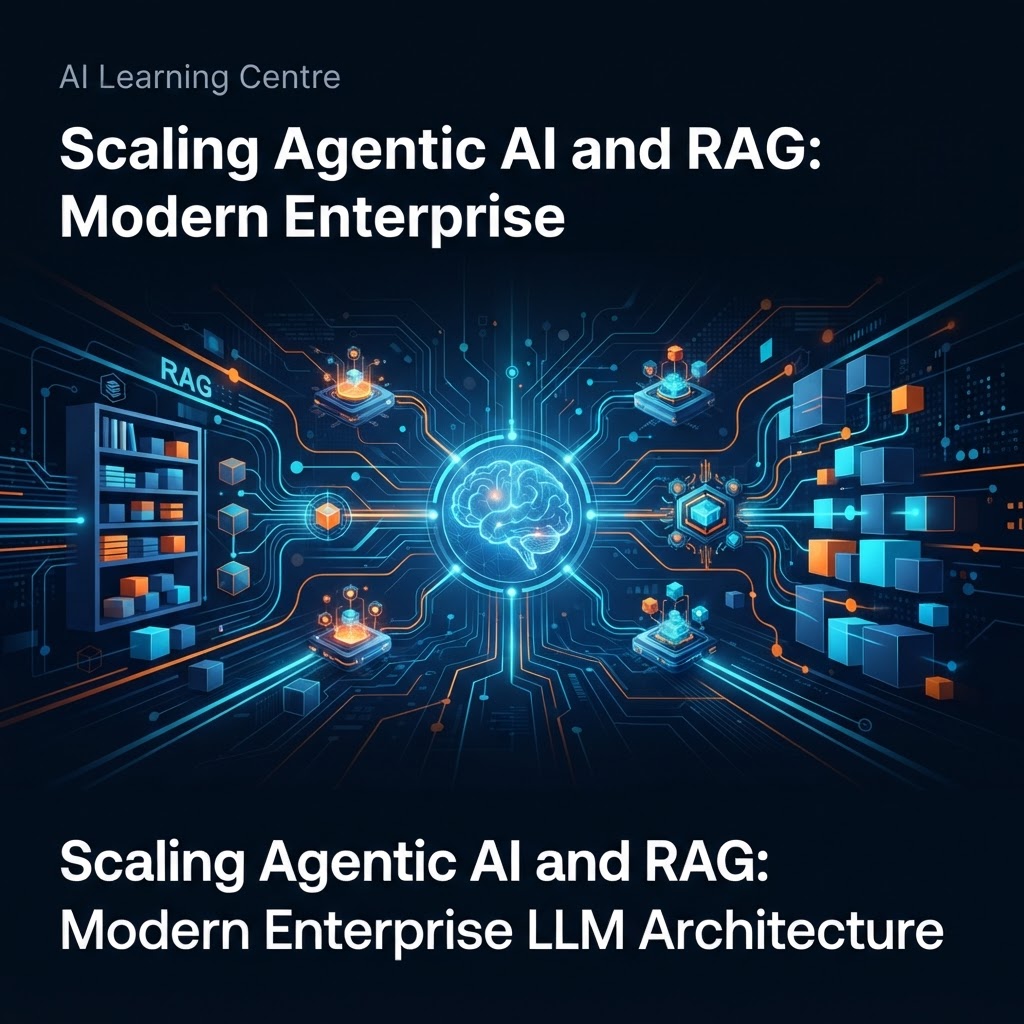
Scaling Agentic AI and RAG: Modern Enterprise LLM Architecture
Enterprises are rapidly transitioning from naive chat interfaces to advanced RAG pipelines and autonomous AI agents. Discover the architecture, frameworks, and governance strategies shaping the future of production-grade Generative AI.
CodeDexters Academy AI
The Shift from Standalone LLMs to Agentic AI and RAG
The artificial intelligence landscape is witnessing a structural shift. The novelty of raw Large Language Model (LLM) interfaces has given way to rigorous engineering demands. Business leaders and technology professionals are finding that off-the-shelf generative systems lack proprietary context, struggle with factual accuracy, and cannot execute multi-step workflows autonomously.
To bridge this divide, enterprises are pivoting heavily toward integrated ecosystems combining advanced Retrieval-Augmented Generation (RAG) and AI Agents. According to industry analyses compiled by Squirro, RAG has evolved into a fundamental cornerstone of enterprise AI architecture, enabling organizations to move beyond exploratory pilots and deploy reliable, scalable production systems.
Moving Beyond Naive RAG Architectures
Basic RAG implementations—commonly known as "naive RAG"—typically rely on simple vector similarity matching to feed external documents into an LLM prompt. While sufficient for modest prototypes, enterprise deployments encounter significant hurdles such as hallucinated citations, outdated retrievals, and context window overflows.
As outlined in comprehensive research detailed on Prompting Guide, state-of-the-art RAG systems now incorporate multi-stage pipelines:
- Hybrid Search Retrieval: Combining dense vector embeddings with sparse keyword search (BM25) to preserve semantic intent alongside exact lexical accuracy.
- Re-ranking and Context Filtering: Prioritizing retrieved documents using cross-encoders before passing them to the generator to eliminate noise and minimize token overhead.
- Hallucination Mitigation: According to a comprehensive academic review published on arXiv, integrating internal datasets and verified repositories drastically reduces hallucination rates, making RAG indispensable across high-stakes verticals like legal analysis, compliance, and enterprise data discovery.
The Rise of Autonomous AI Agents in Enterprise Workflows
While RAG equips language models with specialized memory and contextual retrieval, AI Agents grant them the agency to act. Modern agentic systems do not just answer questions; they plan, reflect, and interact directly with enterprise APIs, databases, and third-party software.
Industry surveys, including insights from the LangChain State of AI Agents Report, highlight that thousands of engineers and business leaders are embedding agents into production workflows. Rather than treating agents as speculative buzzwords, forward-looking teams are using them to:
- Automate Dynamic Tasks: Decompose complex user goals into programmatic steps, invoking function calling and API wrappers.
- Integrate Systems via Multi-LLM Routing: Route specific sub-tasks to smaller, domain-specific models while reserving massive frontier models for high-level reasoning.
- Facilitate Enterprise Services: Leading technology providers like IBM Newsroom are rolling out specialized AI Integration Services specifically designed to transform end-to-end business operations with agentic AI.
Governance and Responsible AI: Core Requirements for Scale
Operationalizing autonomous agents and advanced RAG architectures introduces significant governance demands. Moving to production requires a commitment to Responsible AI principles:
- Data Privacy and Intellectual Property: Ensuring enterprise retrieval pipelines respect role-based access control (RBAC) so sensitive records are only accessed by authorized personnel.
- Observability and Auditing: Tracking LLM intermediate steps, function calls, and generated context to detect operational drift or unauthorized actions.
- Safety Guardrails: Implementing strict output constraints to prevent prompt injection and data exfiltration.
Conclusion: Building Skills for the Agentic Era
The next competitive frontier in technology is defined by an organization's capacity to build scalable, grounded, and agentic workflows. For executives, developers, and technical leaders, developing competencies in vector search, RAG evaluation, and multi-agent coordination is paramount.
At CodeDexters AI Professional Academy, we are committed to helping technical talent navigate this rapid evolution through rigorous training in generative systems, intelligent agents, and responsible enterprise implementation.
Found this article helpful? Share it with your network:
Related Articles
Explore Your Certification Pathway
Book a consultation with a certification advisor to confirm the right pathway for your role, goals and Early-Bird eligibility.