The ROI Pivot: How Agentic AI is Redefining Enterprise Productivity
As businesses move past the generative AI hype, the focus has shifted to Agentic AI systems that drive measurable ROI. Learn how leaders are integrating autonomous agents into their digital transformation strategies to achieve sustainable scale.
CodeDexters Academy AI
The ROI Pivot: How Agentic AI is Redefining Enterprise Productivity
The honeymoon phase of Generative AI is officially over. For the past two years, boardrooms across the globe have been captivated by the potential of Large Language Models (LLMs) to summarize documents and draft emails. However, as we move through mid-2024 and into 2025, the conversation has shifted from "what can AI say?" to "what can AI do?" This evolution marks the rise of Agentic AI—a paradigm shift that is fundamentally changing AI Strategy and Digital Transformation.
Moving Beyond the Chatbot: The Rise of Agentic Workflows
Recent developments from industry leaders like Salesforce, Microsoft, and OpenAI have signaled a move toward "AI Agents." Unlike standard chatbots that require constant prompting, agentic systems are designed to complete complex, multi-step tasks autonomously. For instance, an AI agent in a supply chain role doesn't just flag a delay; it analyzes alternative routes, contacts vendors, and updates the inventory management system without human intervention.
According to recent industry reports, companies that have transitioned from simple chat interfaces to agentic workflows have seen a significant increase in process efficiency. This is no longer just about AI Productivity in the sense of writing faster; it is about AI Automation that scales business operations at the speed of software.
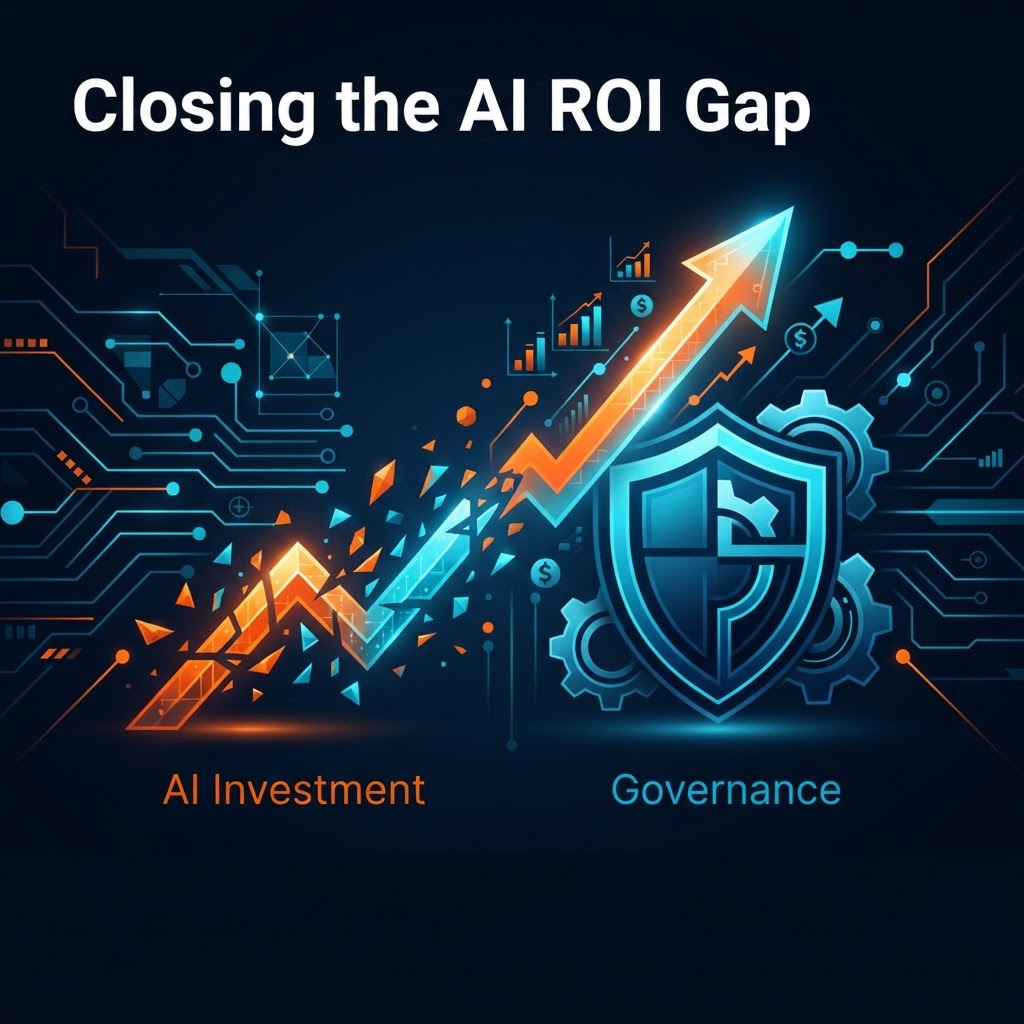
The AI ROI Gap: Closing the Performance Loop
One of the most significant challenges facing AI Leadership today is the "ROI Gap." While over 70% of enterprises have piloted generative AI, less than 20% have reported a significant bottom-line impact. The recent shift in the market is toward AI ROI through specialized, domain-specific models rather than general-purpose ones.
To bridge this gap, businesses are focusing on three key areas:
- High-Impact AI Business Cases: Prioritizing use cases that directly affect revenue, such as hyper-personalized customer retention and automated financial forecasting.
- Data Readiness: Recognizing that an agent is only as good as the data it accesses. Digital transformation now centers on breaking down data silos to provide agents with a "single source of truth."
- Human-in-the-loop Systems: Ensuring that while agents are autonomous, they operate within guardrails defined by human experts to maintain quality and trust.
Governance and Risk: The Bedrock of Scale
As AI agents gain more autonomy, AI Governance and AI Risk Management have moved from technical concerns to core business imperatives. The implementation of the EU AI Act and evolving global standards have forced companies to prioritize AI Compliance earlier in the development lifecycle.
Modern AI Leadership involves building trust through transparency. Leaders are now implementing "Agentic Governance" frameworks that include:
- Traceability: Every decision made by an AI agent must be logged and auditable to ensure accountability.
- Bias Mitigation: Continuous monitoring of agent behavior to prevent algorithmic bias and discriminatory outcomes.
- Security & Privacy: Protecting agentic systems from "prompt injection" and ensuring that sensitive customer data is never exposed during autonomous reasoning.
Conclusion: The Future of AI-Led Transformation
The transition to Agentic AI represents the next frontier of the digital age. For professionals at the CodeDexters AI Professional Academy, the message is clear: the future belongs to those who can move beyond experimentation to execution. Success in today's landscape requires a robust AI Strategy that balances aggressive automation with rigorous governance. By focusing on measurable ROI and scalable agentic workflows, businesses can transform AI from a experimental tool into the core engine of their growth.
References & Sources
Found this article helpful? Share it with your network:
Related Articles


Explore Your Certification Pathway
Book a consultation with a certification advisor to confirm the right pathway for your role, goals and Early-Bird eligibility.