Scaling Agentic AI: Enterprise Strategy and Governance in 2026
Enterprise AI is evolving from isolated chatbots to integrated agentic workflows that drive core business functions. Discover how leaders are leveraging new governance frameworks and data residency solutions to achieve sustainable ROI.
CodeDexters Academy AI
The Shift from AI Pilots to Integrated Agentic Platforms
As we move through 2026, the enterprise landscape has reached a critical inflection point. According to the State of AI in the Enterprise 2026 report by Deloitte, organizations are currently standing at the "untapped edge" of AI's true potential. The era of fragmented, experimental pilots is ending, replaced by a strategic shift toward Agentic AI and integrated platforms that manage the complete AI lifecycle.
Recent data from Stanford HAI’s 2025 AI Index Report highlights this rapid acceleration: 78% of organizations reported using AI in 2024, a significant jump from 55% the previous year. However, the challenge for 2026 is no longer just adoption—it is orchestration and scale.
The Rise of Agentic Workflows
Unlike standard generative AI, which responds to prompts, Agentic AI is designed to execute complex, multi-step workflows with minimal human intervention. Lumenova AI reports that enterprise spending on agentic systems is becoming increasingly business-led, with investments expected to nearly double at the highest budget tiers by 2027.
These agents are being deployed across diverse sectors to handle:
- Agentic Workflow Automation: Moving beyond simple task automation to autonomous process management.
- Customer Support: Providing hyper-personalized, context-aware resolutions.
- Data Analysis & Extraction: Summarizing vast datasets to inform real-time leadership decisions.
Governance: The Catalyst for Full-Scale Adoption
A major barrier to scaling AI has historically been risk management. However, new developments in AI Governance are finally providing the guardrails necessary for deep integration. A pivotal example is OpenAI’s recent advancement in data residency, which allows UK-based enterprises to keep their data within local borders.
This development has already triggered high-stakes adoption. The UK Ministry of Justice recently signed a landmark deal to provide 2,500 civil servants with access to ChatGPT Enterprise. This move signals a transition from public sector testing to full-scale deployment in sensitive, high-compliance environments.
Navigating the Regulatory Landscape
For business leaders, staying compliant is a moving target. The EU AI Act, while formally entered into force in 2024, continues to see phase-in adjustments through 2026. High-risk systems now face extensive requirements regarding data governance and transparency.
To manage these complexities, firms are turning to frameworks like the Databricks AI Governance Framework, which emphasizes five foundational pillars for responsible AI. This is crucial, as Economist Impact research found that 40% of technology executives still believe their current governance programs are insufficient to ensure safety and compliance.
Strategies for AI Leadership and ROI
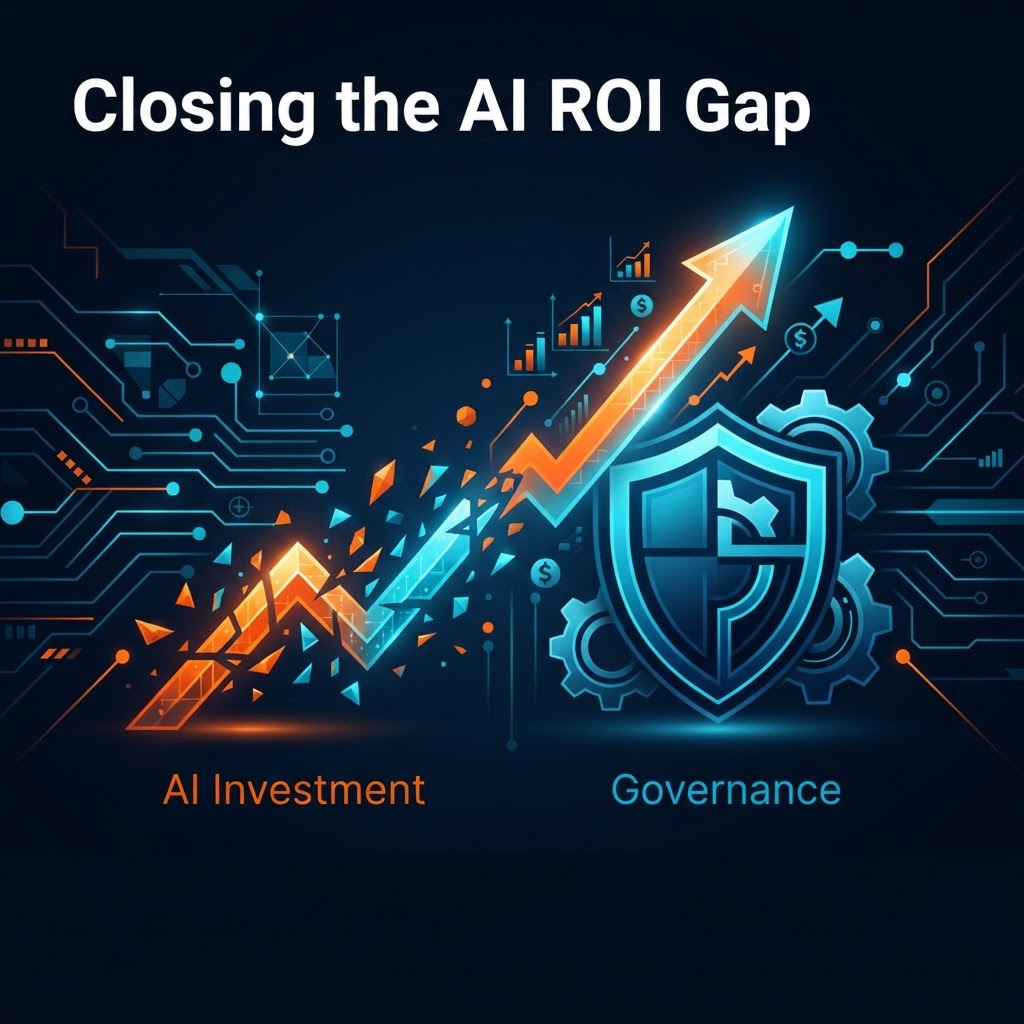
To achieve sustainable AI ROI, leaders must move away from purchasing isolated tools. The trend for 2026 is the "Integrated Platform" approach. As noted by IBM, companies that combine strong data governance with a willingness to rethink current ways of working are seeing the most measurable results.
Key Leadership Actions for 2026:
- Prioritize Integrated Platforms: Invest in systems capable of monitoring, auditing, and continuous improvement rather than standalone apps.
- Focus on Data Residency: Ensure your AI providers meet local compliance and security standards to unlock use in core business functions.
- Upskill for Governance: As the market for AI governance expands, there is a growing demand for skilled professionals who can implement technical controls.
Conclusion
The transition from generative experiments to agentic ecosystems is the defining business trend of 2026. By focusing on robust governance and integrated strategy, leaders can move past the "test project" phase and into a new era of digital transformation. The organizations that succeed will be those that view AI not just as a tool for productivity, but as a structural force requiring sophisticated leadership and rigorous risk management.
Found this article helpful? Share it with your network:
Related Articles


Explore Your Certification Pathway
Book a consultation with a certification advisor to confirm the right pathway for your role, goals and Early-Bird eligibility.