
Beyond the Pilot: Why Work Redesign is the Key to AI ROI in 2026
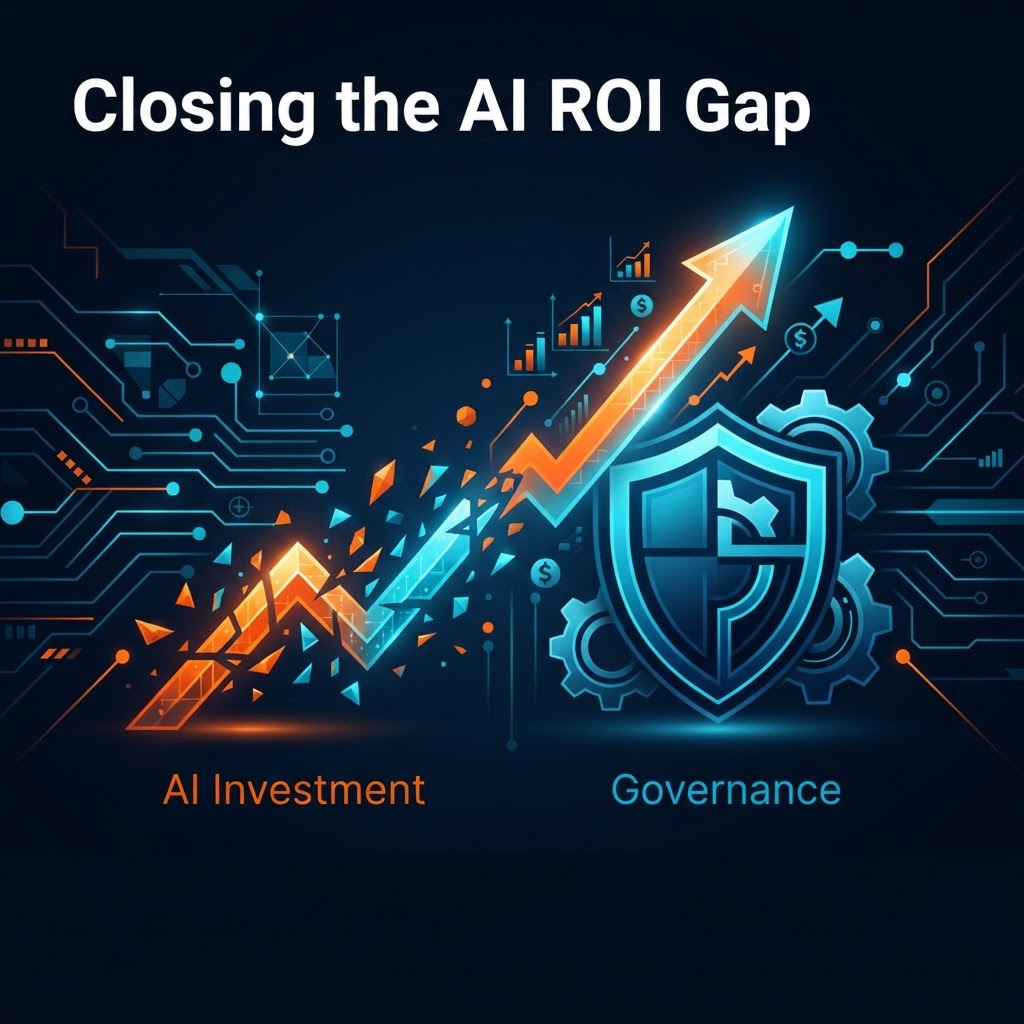
While 76% of executives see AI's value, only 7% have achieved clear ROI. This post explores how work redesign and governance are the missing links in 2026's AI strategy.
CodeDexters Academy AI
Beyond the Pilot: Why Work Redesign is the Key to AI ROI in 2026
The honeymoon phase of artificial intelligence is officially over. In 2026, the conversation has shifted from "what can AI do?" to "how do we make it pay off?" For leaders at the helm of digital transformation, the latest data presents a sobering reality: while the perceived value of AI is skyrocketing, the path to measurable return on investment (ROI) remains narrow.
The ROI Paradox of 2026
According to the KPMG Q2 2026 Report, a staggering 76% of senior executives report that AI is already creating meaningful business value—a 12% increase from the previous quarter. However, there is a significant disconnect: only 7% of those same companies have achieved a clear, documented ROI.
This "ROI Paradox" suggests that while AI is improving sentiment and perhaps individual tasks, it has yet to move the needle on the bottom line for the vast majority of enterprises. The reason? Most organizations are treating AI as a "plug-and-play" tool rather than a fundamental shift in business operations.
The Leadership Test: Redesigning the Workflow
The most critical development in 2026 is the realization that deploying a "Copilot" is the easy part; the real challenge lies in work redesign. Recent research from the Deloitte AI Institute reveals that 48% of organizations have introduced AI without redesigning the workflows or roles it inhabits.
For AI to deliver on its promise, leadership must move beyond experimentation. This involves:
- Role Evolution: Shifting human responsibilities from execution to oversight and strategic decision-making.
- Process Overhaul: Eliminating legacy steps that are no longer necessary in an AI-augmented environment.
- Outcome-Based Design: Focusing on specific business outcomes rather than just "adding AI" to existing tasks.
As Deloitte notes, this tension is the difference between mere experimentation and measurable performance improvement.
The Rise of Agentic AI and Automation
One of the most promising avenues for closing the ROI gap is the shift toward "Agentic AI." Unlike standard generative models that require constant prompting, AI agents can execute multi-step workflows autonomously. Nearly 90% of businesses now view agentic AI as a competitive advantage, with spending in this sector expected to reach $47 billion by 2030, according to Workday.
However, this shift brings new risks. Gartner predicts that over 40% of agentic AI projects will be canceled by the end of 2027 due to weak business cases or poor risk management. This underscores the need for a proactive AI strategy that prioritizes high-return use cases over "vanity demos."
Productivity Gains vs. Governance Maturity
The productivity benefits of AI are undeniable, particularly in technical roles. A study by the Info-Tech Research Group found that 94% of developers report meaningful productivity improvements. Furthermore, 83% of respondents reported a reduction in defects in shipped code.
Despite these gains, governance maturity continues to lag. Many organizations are operating without formalized AI governance policies, which creates significant risk. Effective governance is no longer just about compliance; it is a strategic enabler. By embedding frameworks like the NIST AI Risk Management Framework early in the journey, companies can build systems that are trusted, explainable, and resilient.
Conclusion: The Path Forward for AI Leaders
To succeed in the second half of the decade, business leaders must transition from being AI adopters to AI architects. The "AI factories" of the future—as predicted by MIT Sloan—will be built on a foundation of redesigned work, rigorous ROI discipline, and robust governance.
The window for passive observation has closed. Organizations that fail to redesign their workflows around AI today will find themselves among the 40% of failed projects tomorrow. For those who embrace the challenge of transformation, the rewards are not just incremental—they are exponential.
Found this article helpful? Share it with your network:
Related Articles


Explore Your Certification Pathway
Book a consultation with a certification advisor to confirm the right pathway for your role, goals and Early-Bird eligibility.