Beyond Pilot Purgatory: The 2026 Shift to Agentic AI ROI
With worldwide enterprise AI spending hitting record highs, business leaders face an AI ROI paradox. Discover how top organizations are leveraging agentic workflows and modern AI governance to turn pilots into bottom-line EBIT impact.
CodeDexters Academy AI
Beyond Pilot Purgatory: Why AI Governance and Agentic Workflows Define Enterprise ROI
Enterprise artificial intelligence has officially crossed a major threshold. Worldwide AI spending is surging at double-digit growth rates, and landmark benchmarks from McKinsey and Gartner indicate that nearly 88% of enterprises now utilize AI across at least one business function.
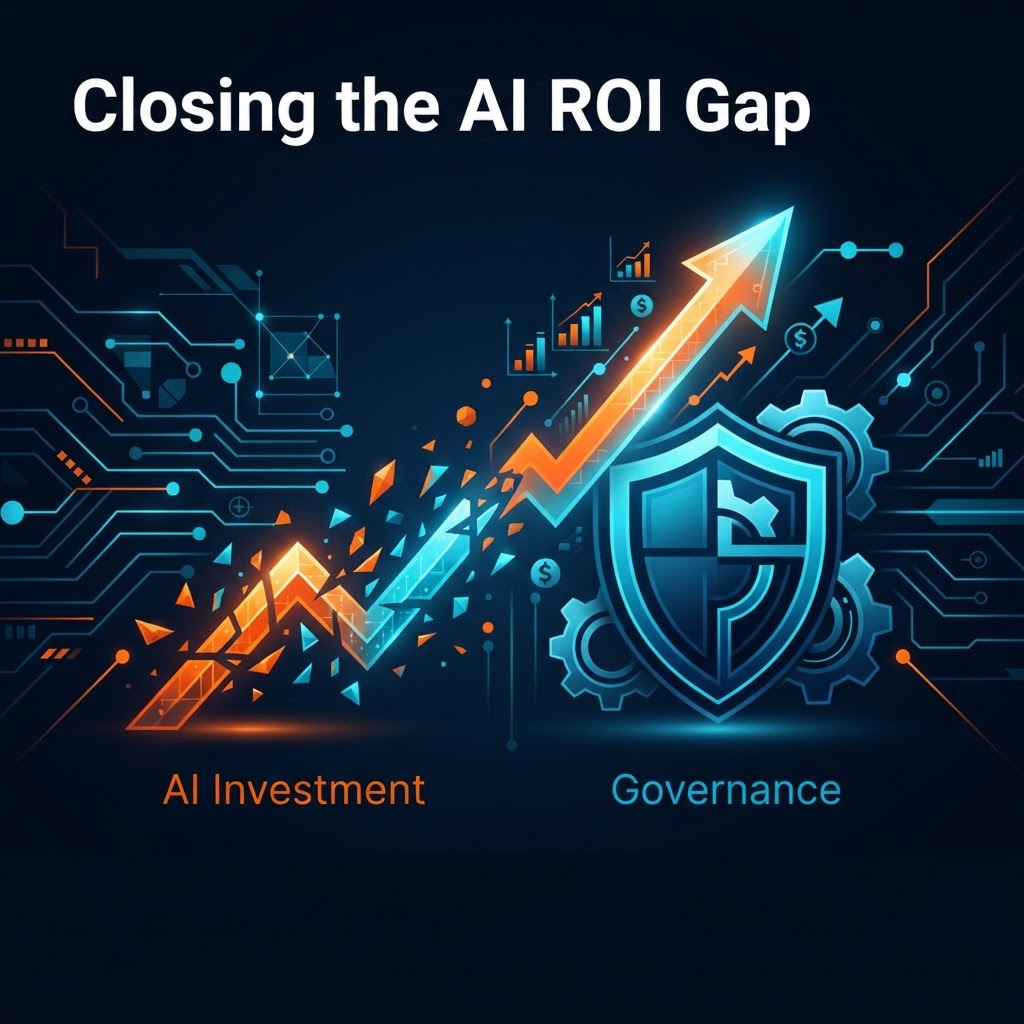
Yet behind these aggressive adoption figures lies an escalating paradox for the C-suite: only 39% of organizations report measurable earnings-before-interest-and-taxes (EBIT) impact from their AI investments. Furthermore, an alarming 42% of enterprise AI initiatives are abandoned between proof of concept (PoC) and production deployment.
As organizations confront this "pilot purgatory," the enterprise AI conversation has pivoted sharply away from experimental generative chatbots. In its place emerges a disciplined focus on Agentic AI orchestration, operational redesign, and rigorous AI governance.
The AI ROI Paradox: Why Standalone Tools Fail to Scale
For the past two years, many enterprises approached AI adoption through superficial tool deployment—layering off-the-shelf generative assistants on top of legacy architectures.
The latest data explains why this strategy hits a wall:
- The Workflow Redesign Gap: A recent Deloitte enterprise study revealed that 48% of organizations introduced AI without redesigning the underlying business processes or workforce roles, while only 12% executed redesign at scale.
- The "High Performer" Advantage: Just 6% of organizations qualify as AI high performers (capturing over 5% of enterprise EBIT from AI). These market leaders are nearly three times more likely to fundamentally reconstruct their workflows around AI rather than retrofitting tools into existing silos.
- The Middleware Squeeze: Fragmented software licenses and isolated point solutions create technical debt without delivering enterprise-wide operating visibility.
Without aligning AI directly to business cases and systemic operational transformation, AI initiatives remain cost centers rather than revenue accelerators.
The Rise of Agentic AI: Moving from Copilots to Autonomy
The most consequential technical development bridging the ROI gap is the migration toward Agentic AI.
Unlike passive chatbots that require continuous human prompting, agentic systems possess contextual reasoning and multi-step execution capabilities. They coordinate across ERPs, CRMs, and internal databases to resolve exceptions, automate procurement pipelines, and streamline complex compliance workflows autonomously.
Gartner forecasts that by the end of 2026, 40% of enterprise software applications will feature task-specific AI agents, compared to less than 5% just a year prior. By shifting routine decision-making away from manual oversight, early adopters are seeing realized returns within 6 to 12 months, driven by drastically reduced cycle times and automated error reduction.
AI Governance: The Non-Negotiable Infrastructure
As autonomy increases, so does operational risk. Deploying autonomous agents across core systems without guardrails invites significant data privacy leaks, compliance violations, and unpredictable hallucinations.
Consequently, modern AI Governance has shifted from a compliance afterthought to foundational enterprise infrastructure:
- Automated Guardrails & Telemetry: Enterprise CIOs and CISOs are prioritizing real-time observability platforms to audit agent behavior, control database read/write permissions, and verify reasoning pathways before execution.
- Regulatory Compliance Readiness: Frameworks like the EU AI Act and evolving global compliance standards require auditable accountability trails for automated decisions, particularly in finance and healthcare.
- Trust & Risk Management: Autonomy without strict identity access management (IAM) turns autonomous agents into high-risk vectors. Forward-thinking leaders are embedding human-in-the-loop (HITL) triggers whenever financial or operational thresholds are crossed.
Strategic Blueprint for AI Leaders
To move out of experimentation and join the top 6% of value creators, executive leadership must enact three core mandates:
- Audit for Business Case Viability: Retire lingering PoCs that cannot demonstrate quarter-over-quarter efficiency gains or clear revenue attribution. Focus capital strictly on mission-critical bottlenecks.
- Re-architect Operating Workflows: Treat AI as an embedded operating capability. Redefine job roles, upskill staff to orchestrate multi-agent workflows, and decommission redundant legacy SaaS subscriptions.
- Institutionalize Governance Early: Standardize responsible AI policies and automated monitoring before deploying autonomous agents into customer-facing or transactional environments.
Conclusion: The Path Forward with CodeDexters AI
The era of vanity AI metrics is over. The enterprises pulling ahead are not those with the most AI pilots, but those with the governance architecture, workflow transformation, and leadership capability to turn autonomous systems into bottom-line business value.
At CodeDexters AI Professional Academy, we prepare current and aspiring business leaders, strategists, and technical architects to navigate this shift. Explore our executive certifications in AI Strategy, Enterprise AI Governance, and Agentic Automation to turn AI potential into measurable business impact.
Found this article helpful? Share it with your network:
Related Articles


Explore Your Certification Pathway
Book a consultation with a certification advisor to confirm the right pathway for your role, goals and Early-Bird eligibility.