Agentic AI: The Next Frontier for Enterprise Strategy and ROI
Enterprise AI is shifting from passive chatbots to autonomous agents capable of executing complex workflows. This shift promises to bridge the AI ROI gap by driving significant gains in productivity and operational efficiency through advanced automation.
CodeDexters Academy AI
Introduction
The enterprise AI landscape has reached a pivotal turning point in late 2024 and early 2025. While the previous year was defined by the initial wonder of Large Language Models (LLMs) and generative chatbots, the conversation has rapidly shifted toward "Agentic AI." This evolution represents a move from passive tools that answer questions to active agents that complete tasks autonomously. For business leaders and professionals at CodeDexters AI Professional Academy, understanding this transition is critical for maintaining a competitive edge in the next phase of digital transformation.
From Chatbots to Autonomous Agents
The primary limitation of early AI adoption was its dependence on human prompting to initiate every single step. Agentic AI changes this dynamic. These systems are designed to perceive their environment, reason through complex goals, and take autonomous actions across multiple software platforms. Unlike standard generative AI, which serves as a co-pilot, Agentic AI functions as a digital employee.
Recent major announcements from industry giants have solidified this trend. Salesforce recently launched "Agentforce," a suite of autonomous agents that can handle tasks in sales, service, and marketing without human intervention. Similarly, Microsoft has updated its Copilot Studio to allow businesses to build agents that can independently manage supply chain logistics or process insurance claims. These are not just incremental updates; they represent a fundamental shift in AI Strategy.
Bridging the AI ROI Gap
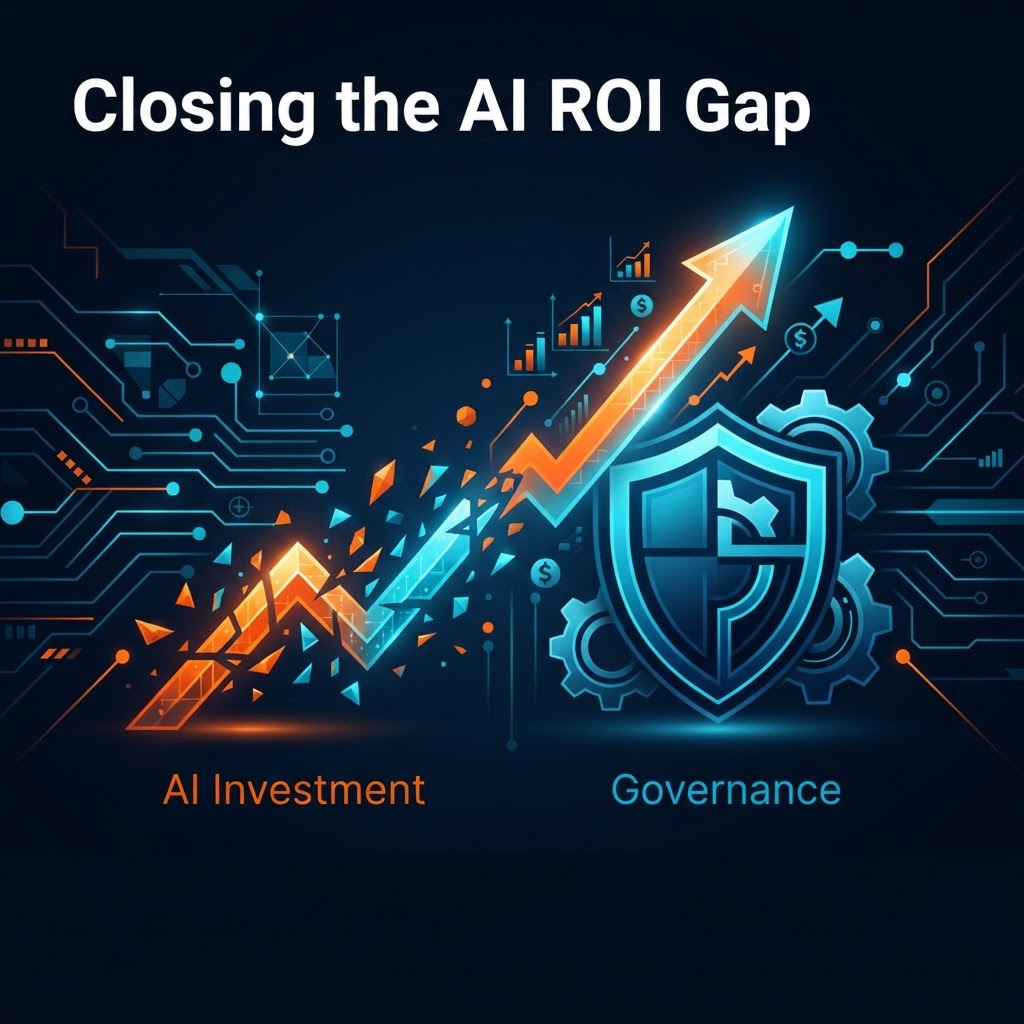
A major concern for C-suite executives this year has been the "ROI Gap"—the distance between heavy investment in AI infrastructure and tangible bottom-line results. Agentic AI directly addresses this by moving beyond simple content generation toward end-to-end process automation.
Key Business Cases for Agentic Workflows:
- Automated Sales Operations: Agents that can research prospects, qualify leads based on real-time data, and schedule meetings without a human intermediary.
- Proactive Customer Success: AI that monitors product usage patterns and initiates troubleshooting or upselling workflows before a customer even identifies a need.
- Dynamic Supply Chain Management: Autonomous agents that adjust procurement orders and logistics routes in response to real-time weather events, port congestion, or sudden demand spikes.
By automating these high-value workflows, organizations can finally realize the productivity gains that were promised at the start of the generative AI boom.
AI Governance and the Human-in-the-Loop
As AI takes more autonomous actions, AI Governance and AI Risk Management become significantly more complex. When an agent has the authority to interact with customers or commit financial resources, the stakes are much higher than when it is simply drafting an email.
Forward-thinking AI Leadership must prioritize the implementation of "guardrails." This includes defining the exact parameters within which an agent can operate and ensuring that a "human-in-the-loop" remains for high-stakes decision-making. Furthermore, with the maturation of regulations like the EU AI Act, AI Compliance is no longer optional. Organizations must maintain transparent audit trails of every autonomous action taken by their AI agents to mitigate legal and reputational risks.
Building an Agentic Roadmap
To transition from generative to agentic workflows, leadership must focus on data interoperability. Agents are only as effective as the data they can access and the systems they can manipulate. Companies must prioritize a unified data layer to allow AI agents to navigate between siloes seamlessly. This requires a robust Digital Transformation strategy that aligns technical capabilities with specific business outcomes.
Conclusion
The shift to Agentic AI represents the true fulfillment of the AI promise for business. It is no longer about having a tool that helps you write or brainstorm; it is about building a digital workforce that helps you execute. As we move further into 2025, the winners in the marketplace will be those who can move past the experimental phase of GenAI and integrate autonomous agentic workflows into their core business architecture. At CodeDexters AI Professional Academy, we believe this is the ultimate path to sustainable AI ROI and leadership in the digital age.
Found this article helpful? Share it with your network:
Related Articles


Explore Your Certification Pathway
Book a consultation with a certification advisor to confirm the right pathway for your role, goals and Early-Bird eligibility.